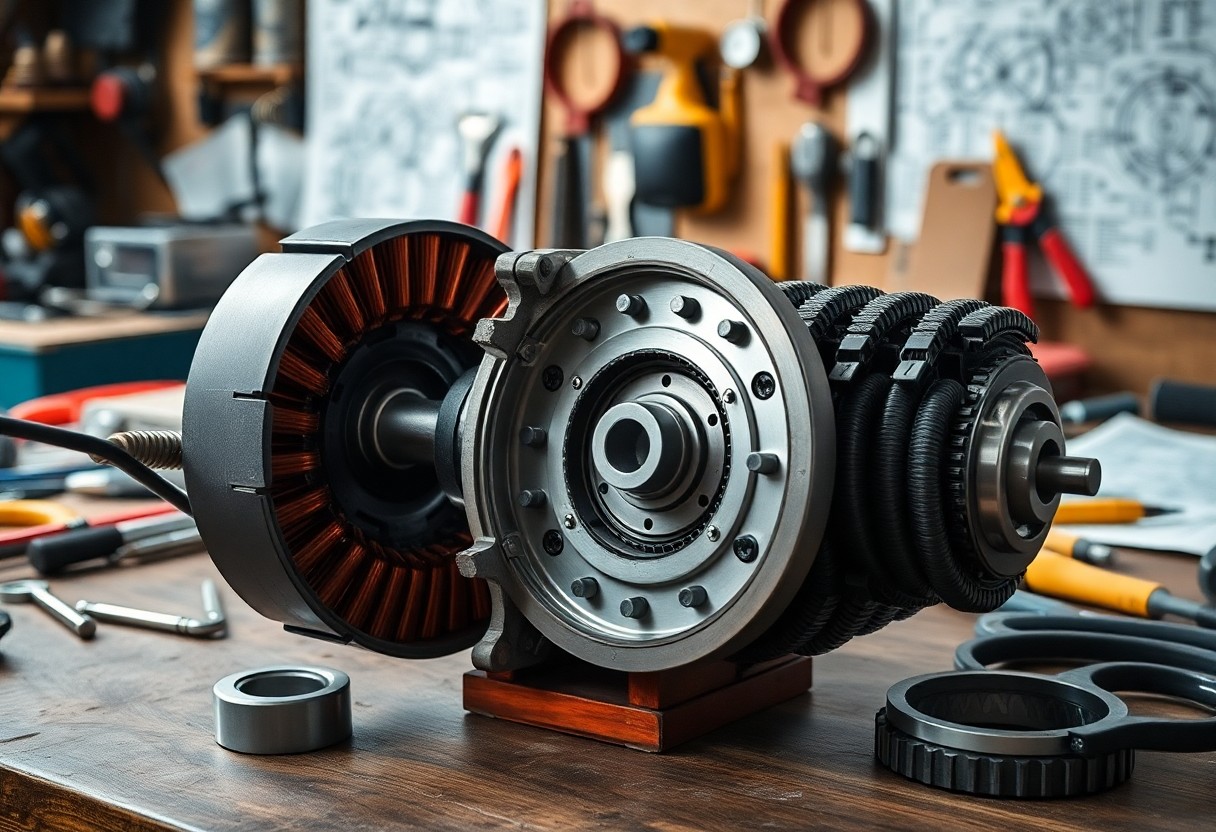
Components of an electromotor are crucial for its operation and efficiency. By familiarizing yourself with these parts, you unlock a deeper understanding of how electricity is transformed into mechanical motion. Understanding the stator, rotor, and other components can help you troubleshoot issues and optimize performance, ensuring safety in your electrical projects. This guide will provide you with the insights needed to confidently engage with electromotors, whether for hobby projects or professional applications.
Types of Electromotors
| Type | Description |
|---|---|
| AC Motors | Used primarily for applications that require constant speed. |
| DC Motors | Preferred for applications with variable speed requirements. |
| Stepper Motors | Enable precise control over position and speed. |
| Servo Motors | Provide closed-loop control, allowing for high accuracy. |
| Universal Motors | Capable of operating on both AC and DC power. |
You will find that the predominant types are AC motors and DC motors. AC motors are typically used in applications requiring a consistent speed, like fan systems or conveyor belts, making them suitable for industrial as well as household appliances. They operate on alternating current and are characterized by their simplicity and durability. On the other hand, DC motors are favored in situations that demand variable speed, such as electric vehicles or portable power tools. These motors function on direct current and allow for precise control over the rotational speed, offering great flexibility in operation.
AC Motors
AC motors can be further divided into two primary sub-types: synchronous and asynchronous (induction) motors. Synchronous motors operate at a constant speed that is synchronized with the frequency of the AC supply, often used in applications demanding high efficiency and reliability. Asynchronous motors, commonly referred to as induction motors, do not require synchronization and are widely used due to their ruggedness and simplicity; they are the backbone of industrial motor usage. Both types are integral in driving machinery, fans, and pumps efficiently, showcasing their versatility and robust applications.
DC Motors
DC motors are distinct in their ability to provide variable-speed operation and high torque at start-up. They are widely used in applications where such characteristics are crucial, like electric vehicles and robotics. You may encounter brushed and brushless variations, each offering unique benefits: brushed motors are simpler and lower cost, while brushless motors boast higher efficiency and longer life spans due to reduced wear and tear. The choice between these types largely depends on your application specifics.
Delving deeper into DC motors, it’s noteworthy that they often incorporate electronic controllers to manage speed and direction, enhancing their adaptability. Moreover, variations like stepper motors, which are crucially a type of DC motor, allow for precise positioning capabilities, making them ideal for 3D printers and CNC machines. Recognizing the diverse applications, it’s evident that understanding the distinct types of motors empowers you to make informed choices tailored to your specific needs.
Key Components of an Electromotor
Stator
The stator is the stationary part of the electromotor, playing a pivotal role in producing magnetic fields necessary for operation. Typically composed of laminated iron cores, it houses windings that are energized by alternating current (AC) or direct current (DC), creating a magnetic field that interacts with the rotor. In essence, the design and configuration of the stator directly impact the efficiency and torque characteristics of the motor, making it critical to consider factors such as the number of poles, winding material, and core composition when evaluating performance.
Additionally, the stator must effectively dissipate heat generated during operation to prevent damage or inefficiency. Advanced designs may incorporate thermal management technologies, including cooling fins or heat sinks, particularly in applications with high energy demands. When you choose a motor, it’s important to assess the stator’s construction and its ability to handle expected loads, as this significantly influences the motor’s lifetime and reliability.
Rotor
In contrast, the rotor is the rotating element, responsible for converting electrical energy into mechanical energy. Comprising conductive materials, it typically consists of a core and windings or bars, depending on the motor type. The interaction between the rotor and stator’s magnetic field creates torque, propelling the rotor to turn. It’s important to note that the rotor’s design can vary widely; for example, the squirrel cage rotor, commonly used in AC motors, features short-circuited conductors that require minimal maintenance yet provide excellent performance.
Moreover, rotor dynamics are vital to motor efficiency. Unbalanced rotors can lead to excessive vibration and wear, potentially shortening their operational lifespan. Careful attention to rotor size, weight distribution, and material selection will enhance performance and lifetime, making it vital for you to consider these aspects when selecting a motor for your application.
More on Rotor
The rotor’s performance can also be influenced by factors such as slip-especially in induction motors-where a difference exists between the stator’s magnetic field speed and the rotor’s actual speed. Understanding slip is important, as it affects torque production and efficiency. For instance, a higher slip can lead to reduced efficiency and increased heating. Therefore, maximizing rotor design and performance is crucial for achieving optimal motor functionality, particularly in applications demanding high reliability and efficiency.
Tips for Selecting the Right Electromotor
When choosing an electromotor, several factors come into play that can significantly affect your application’s performance. Start by assessing the power requirements based on your operational needs. The motor’s voltage and the load it will bear need careful consideration to ensure compatibility. Efficiency ratings should also be on your checklist. A higher efficiency motor, while often more expensive upfront, can yield substantial savings over time through reduced energy costs.
- Type of motor suitable for your application
- Power output that meets your demands
- Efficiency ratings for long-term savings
- Size and weight to fit your installation parameters
Perceiving each of these aspects in detail will guide you toward making an informed decision.
Application Considerations
Evaluating the specific application for which you need the electromotor is vital. Different industries have unique operational requirements, whether it’s for manufacturing, HVAC systems, or electric vehicles. Each application may necessitate a different type of motor, whether it’s an AC or DC motor, based on the needed output and operational environment.
Take particular note of the surrounding conditions in which the motor will operate. Factors such as temperature, humidity, and exposure to contaminants can influence the motor’s longevity and efficiency. Selecting a motor that is rated for its environment ensures reliable operation and reduces maintenance costs.
Efficiency Ratings
Efficiency ratings are a critical dimension to consider when selecting the right electromotor. The efficiency of a motor often directly correlates with its energy consumption, operational costs, and environmental impact. Motors are usually rated by their efficiency percentage, with a higher value signifying less energy loss and more effective performance. For example, while a typical motor may range around 85% efficiency, high-efficiency models can reach up to 95% or more, translating to significant energy cost reductions.
Also, bear in mind that the efficiency of a motor can vary depending on the load it bears. Operating a motor at or near its rated load generally results in optimal performance. In contrast, running it under very low loads can diminish efficiency; hence, understanding the operational profile is necessary for maximizing benefits.
Step-by-Step Guide to Electromotor Installation
Preparation
Before stepping into the installation of your electromotor, a few preliminary steps will ensure a smooth process. Begin by gathering all necessary tools and materials, including screwdrivers, wire strippers, and proper safety gear such as gloves and goggles. Lay out your workspace to minimize distractions and help you locate components quickly. This organizational step will enhance your efficiency and safety throughout the project.
Also, ensure that the power supply is shut off in the area where you’ll be working. This precaution protects you from electric shocks and keeps the installation process safe. When it’s time to install the motor, verify that the mounting area is clean and free of debris that could affect the motor’s operation. Confirm that the motor’s specifications match your project’s requirements to guarantee optimal performance.
Wiring and Connections
Wiring your electromotor correctly is a fundamental part of the installation that directly impacts its functionality. Connect the wires according to the manufacturer’s wiring diagram, paying close attention to the color codes and terminal designations. If the electromotor is AC, you may need to connect live, neutral, and ground wires appropriately. For DC motors, ensure the power cables are secured to the correct terminals. Any mistake in this step can lead to inefficiency or even damage to the motor.
Utilize insulated connectors to secure your connections, which helps prevent accidental disconnections or short circuits. Make sure to double-check each connection before moving forward, as loose wiring can lead to electrical failures. After you’ve completed the wiring, carefully test the connections with a multimeter to confirm that everything is intact and operating as expected.
It’s vital to keep in mind that improper wiring can not only hinder the motor’s performance but can also pose significant safety risks. For instance, overheating due to incorrect connections can lead to motor failure or even fire hazards. Meter readings should guide you in verifying that voltage and current levels are within specified limits, ensuring a safe and effective installation.
Factors Influencing Electromotor Performance
Your electromotor’s performance hinges on various elements that can either enhance or diminish its efficiency. Key factors include load characteristics, environmental conditions, and supply voltage. Managing these factors is crucial for optimizing your motor’s operation. For instance, the load characteristics directly influence how efficient the motor runs under different conditions, while adverse environmental factors can induce wear and affect longevity.
- Load characteristics
- Environmental conditions
- Supply voltage
Load Characteristics
The load characteristics of your electromotor dictate how it responds to varying loads during operation. If the load is too high, the motor may stall or overheat, leading to potential damage. Conversely, a light load can result in ineffective energy use, impacting overall performance and increasing energy consumption. By understanding the specific load requirements for your application, you can optimize the electromotor’s settings for better efficiency.
For example, motors in industrial settings often experience fluctuating loads. Utilizing a variable frequency drive (VFD) enables you to adjust the motor’s speed according to the load demand, enhancing performance while conserving energy. In essence, aligning the motor with the operational load requirements can prolong its lifespan and improve overall productivity. Thou must ensure that the motor’s capacity matches your application to avoid performance issues.
Environmental Conditions
The environmental conditions surrounding your electromotor can significantly impact its functionality and durability. Factors such as humidity, temperature fluctuations, and dust can lead to performance degradation or failure. For instance, extreme temperatures may cause thermal expansion issues, affecting the motor components. Adequately addressing these environmental variables is vital for optimal electromotor performance.
You must also consider the installation environment. If your motor operates in a wet or corrosive atmosphere, implementing protective enclosures and suitable materials will mitigate potential damage. Additionally, maintaining proper ventilation within the installation area ensures sufficient cooling, ultimately supporting the motor’s efficiency and lifespan. Thou should remain vigilant about these conditions to maximize your electromotor’s productivity and reliability.
Pros and Cons of Electromotor Types
Pros and Cons of Electromotor Types
| Pros | Cons |
|---|---|
| High efficiency | Initial cost can be high |
| Low maintenance | Complex control systems |
| Environmentally friendly | Temperature sensitivity |
| Wide range of applications | Noise in operation |
| Compact size | Power limitations in some models |
Advantages
You benefit from several advantages when choosing electrifying motors. Their high efficiency translates into lower energy consumption, which can significantly reduce operational costs over time. For example, a well-designed electromotor can achieve efficiency ratings above 90%, making it a great choice for various applications in industries like manufacturing and automotive. You’ll find that they also require minimal maintenance, as they lack many moving parts compared to traditional motors, leading to less wear and tear.
Electromotors are environmentally friendly alternatives that produce no direct emissions, supporting initiatives aimed at reducing your carbon footprint. Their compact size allows for easy integration into a variety of machines and systems, making them preferable in applications where space is at a premium. This versatility equips you to enhance product designs without compromising performance.
Disadvantages
There are some shortcomings to consider when evaluating electromotor types for your projects. One of the primary issues you may encounter is that the initial cost of purchasing and installing electromotors can be substantially higher than traditional alternatives. In addition, the complex control systems required to optimize their performance can demand advanced technical skills and knowledge, potentially increasing training costs for personnel.
Furthermore, temperature sensitivity can limit the operating range of some electromotor types, posing challenges in extreme environmental conditions. This can affect durability and performance if not properly managed. The noise generated by electromotors during operation can also be a consideration, especially in environments where quiet operation is crucial. Lastly, be aware of the potential power limitations in specific models which may restrict their usage for certain high-demand applications.
Summing up
Considering all points, you have gained a solid understanding of the various components that make up an electromotor. Each part, from the rotor and stator to the power supply and commutation system, plays a vital role in the motor’s overall function. By familiarizing yourself with these elements, you enhance your ability to troubleshoot and optimize electromotor applications in various settings, from industrial to consumer electronics.
Your knowledge of electromotor components empowers you to make informed decisions when selecting or designing motor systems. Whether you are engaged in engineering, maintenance, or simply seeking to deepen your expertise, grasping how these components interact is important for maximizing efficiency and performance in your projects.

Comments are closed