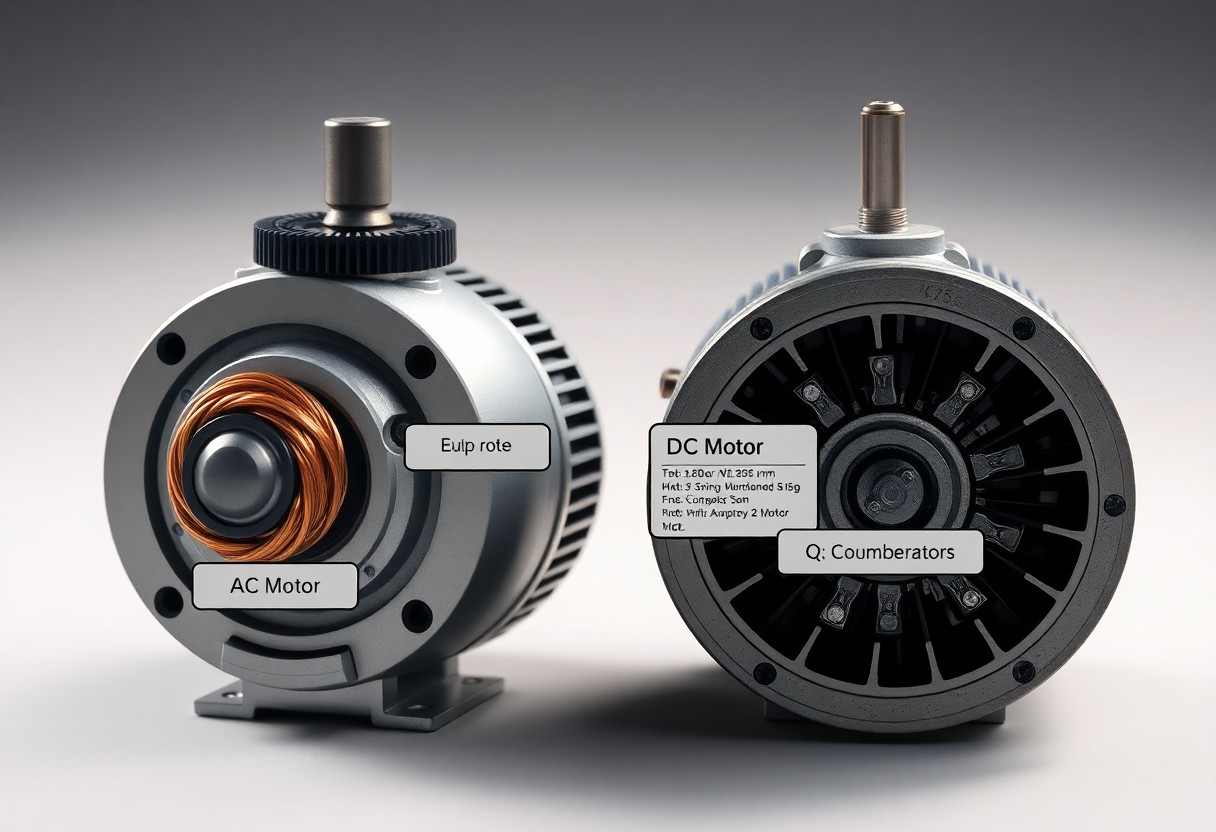
AC motors are widely used in various applications due to their simplicity and efficiency. Understanding the differences between AC and DC electromotors is vital for you to make informed decisions when selecting the right motor for your needs. While AC motors are typically more durable and cost-effective for large-scale operations, DC motors offer precise speed control and are often preferred for smaller devices. This guide will investigate into the key features, advantages, and potential drawbacks of both types, ensuring you have the knowledge to choose wisely.
Types of Electromotors
| Type | Description |
|---|---|
| AC Motor | An electric motor that operates on alternating current. |
| DC Motor | A motor driven by direct current voltage. |
| Induction Motor | Uses electromagnetic induction to produce rotation. |
| Brushless DC Motor | A type of DC motor that uses electronic controllers instead of brushes. |
| Stepper Motor | Divides a full rotation into smaller steps. |
AC Motors
AC motors are widely used in various applications due to their durability and efficiency. They are primarily categorized into two types: synchronous and asynchronous motors. The synchronous motor operates at a constant speed, synchronized with the frequency of the AC supply. On the other hand, the asynchronous motor, also known as an induction motor, can operate at speeds that vary with load conditions. This makes induction motors particularly popular in industrial applications where varying loads are common.
In terms of performance, AC motors generally require less maintenance compared to their DC counterparts since they lack brushes. This leads to a longer lifespan and reduces the likelihood of mechanical failure. The ability to operate on high voltages and the simpler design also contribute to the economic viability of AC motors in applications like fans, pumps, and conveyor systems. Assume that you’re considering the efficiency and cost-effectiveness; AC motors consistently offer significant advantages over other types.
DC Motors
DC motors are favored for their straightforward operation and control. They can deliver high torque at low speeds, making them suitable for applications such as electric vehicles and robotics. Armature and field windings in DC motors provide a robust mechanism for controlling the speed and torque, allowing you to tailor motor performance with precision. Additionally, the use of variable speed drives enhances application versatility, enabling these motors to function effectively across different operating conditions.
While their initial cost can be higher, the efficiency of DC motors in performance-intensive setups justifies the investment. The use of permanent magnets in brushless variants simplifies maintenance requirements further, enhancing reliability in mission-critical applications. Assume that you require precise motion control; you will find that DC motors provide a remarkable balance between performance and responsiveness.
DC motors’ torque characteristics allow for varied operational uses, from simple applications like toys to complex systems like robotics. Their quick response times and ability to integrate with various control circuitry make them ideal for applications needing constant speed and torque adjustments. In environments where smoothness of motion is paramount, the versatility of DC motors truly shines.
Factors to Consider When Choosing Electromotors
When selecting an electromotor, numerous factors play a vital role that can significantly affect performance and efficiency. Start by evaluating the application needs, which directly influence the type of motor necessary for your tasks. It’s crucial to consider the environmental conditions, operational loads, and desired speed and torque output. Additionally, take into account the power supply availability in your location, as compatibility with existing systems can simplify installation and reduce costs.
- Application needs
- Power supply availability
- Efficiency requirements
- Size and weight constraints
Recognizing these factors enables you to make informed decisions tailored to your specific requirements.
Application Needs
Your choice of electromotor should align with the specific applications you plan to use it for. For instance, in an industrial setting, you might require motors that can handle high loads and offer reliable starting torque. In contrast, for consumer electronics, you might prefer smaller, more compact motors that operate at higher speeds. Each application will come with its own set of demands, making it necessary to identify these needs upfront. A misalignment between motor capabilities and application requirements could lead to performance issues, downtime, or even equipment failure.
Power Supply Availability
The power supply availability in your operational area should guide your motor selection as well. Whether you have access to AC or DC sources can dramatically influence your choices. For instance, if you operate in an area where AC power is abundant, AC motors may be more advantageous due to their simplicity and lower maintenance needs. On the other hand, DC motors can be more easily controlled, offering variable speed options suitable for applications requiring precise control, especially in battery-powered devices.
When assessing power supply availability, also consider voltage levels and whether they match the motor specifications, as mismatches could lead to inefficiencies or damage. Opting for motors that align with your electrical infrastructure can contribute to ensuring compatibility and overall system stability. Recognizing these factors can help optimize performance and reduce operational headaches.
Pros and Cons of AC Electromotors
Pros and Cons of AC Electromotors
| Pros | Cons |
|---|---|
| Higher efficiency in large applications | More complex control systems required |
| Cost-effective for widespread use | Higher initial installation costs |
| Less maintenance due to fewer moving parts | Can be less efficient at lower speeds |
| Better for high power applications | Requires an inverter for variable speed |
| Widely available and standardized | Higher starting torque can be an issue |
| Can be easily integrated into existing systems | Potential for harmonics in electrical systems |
| Improved energy management capabilities | Not ideal for low power applications |
| More resilient to overheating | Can require more space for larger units |
| Environmental friendliness due to reduced emissions | Variable speed operations can complicate efficiency |
| Compatibility with renewable energy sources | Limited performance in extreme temperatures |
Advantages
AC electromotors exhibit significant advantages in efficiency, especially when used in large-scale applications. If you’re operating at high power levels, these motors can deliver energy savings that greatly reduce operational costs. For instance, industrial sectors that demand continuous operation, like manufacturing or transportation, often find AC motors to be a reliable choice due to their robustness and longevity.
Another benefit lies in their maintenance requirements. With fewer moving parts compared to their DC counterparts, AC motors typically require less frequent servicing. This reliability allows you to maximize uptime and enhance productivity. Furthermore, advancements in energy management make it easier to integrate AC motors into systems that utilize renewable energy sources, aligning with sustainability goals.
Disadvantages
On the downside, AC motors can present challenges, particularly regarding complexity in control systems. If your setup requires variable speed control, you will need an inverter, which adds to your initial costs and may introduce additional failure points. This added complexity can be a deterrent for smaller operations where simple DC motors could suffice.
Furthermore, while AC motors are highly efficient at higher speeds and loads, their performance may drop considerably in low-speed applications. This inefficiency can lead to increased energy consumption and drive up operational costs in scenarios where speed regulation is critical. If you frequently engage in tasks that require fine speed adjustments, this limitation in AC motor design might complicate your workflow.
Lastly, depending on the application, you’ll want to consider potential overheating issues in AC motors. If not managed appropriately, overheating can lead to motor failure, reducing overall reliability. Combine this with the potential for harmonics that might disrupt electrical systems, and AC motors can sometimes demand more precise engineering and planning to ensure optimal performance.
Pros and Cons of DC Electromotors
Pros and Cons of DC Electromotors
| Pros | Cons |
|---|---|
| High starting torque | Maintenance required due to brushes |
| Simpler speed control | Less efficient at higher speeds |
| Compact design | Limited lifespan of component parts |
| Cost-effective for low-power applications | Heat generation during operation |
| Wide availability and variety | Power supply restrictions |
Advantages
You gain significant benefits when using DC electromotors for various applications. One of the primary advantages is their high starting torque, allowing for immediate acceleration in heavy machinery or electric vehicles. This feature proves vital in scenarios where rapid initial movement is necessary. Additionally, the simplicity of speed control through varying the voltage makes them user-friendly, enabling precise adjustments that are ideal for tasks ranging from conveyor belts to fans.
Another benefit is the compact nature of most DC motors, which requires less space than their AC counterparts. This compactness makes DC motors particularly suited for devices where space is limited, such as robotics and portable tools. Furthermore, their availability in a wide range of sizes and specifications allows you flexibility in selecting a motor that fits your exact needs, whether that’s a small hobby project or an industrial application.
Disadvantages
Despite these advantages, DC electromotors do come with critical downsides. The need for maintenance due to brush wear is a significant consideration, as it can lead to performance issues and added costs over time. Additionally, while they excel at low speeds, DC motors often present efficiency challenges at higher speeds, making them less favorable for high-speed applications compared to AC motors.
Moreover, the lifespan of component parts in a DC motor, particularly the brushes, is limited and can be a concern for long-term use. Frequent replacements can disrupt operations and lead to downtime, impacting overall productivity. Furthermore, these motors tend to generate heat during operation, which can further complicate cooling requirements and lead to efficiency losses, as you may need to implement additional cooling solutions to manage temperatures effectively.
Tips for Selecting the Right Electromotor
Choosing the appropriate electromotor requires careful consideration of various factors to ensure optimal performance for your specific application. Start by clearly defining your performance requirements, such as the required torque output, speed, and operation environment. Understanding these needs allows you to narrow down your options more effectively.
- Torque: Determine the starting and running torque required.
- Speed: Assess the operational speed necessary for your application.
- Voltage: Choose the appropriate voltage level for your system.
- Efficiency: Look for motors that operate efficiently under your specific conditions.
- Type: Decide between AC and DC motors based on your application needs.
Thou must also pay attention to the application environment since it can influence the type of motor you select.
Performance Requirements
When specifying performance requirements, prioritize aspects such as load characteristics and the operational profile. For instance, if your application demands high starting torque, a DC electromotor might be more suitable since it typically excels in providing this feature. Meanwhile, if continuous operation with minimal maintenance is your goal, an AC electromotor is often favored due to its durability and lower wear.
In addition to torque and speed, consider the duty cycle-how long the motor will run and at what load. This detail is vital, as it influences the motor’s lifespan and efficiency. Selecting a motor not tailored to these requirements can lead to inefficiencies, increased wear, or even catastrophic failure in extreme cases.
Maintenance Considerations
Maintenance is an equally imperative factor in your decision-making process. Electromotors require varying levels of upkeep based on design and application. For instance, DC motors typically require more frequent maintenance due to components like brushes, which need regular checking and replacement. On the other hand, AC motors often have longer intervals between maintenance activities and can be more reliable in harsh conditions.
Failure to maintain your electromotor adequately can result in decreased performance and a shorter lifespan. Developing a scheduled maintenance plan that includes regular inspections can mitigate potential issues, ensuring efficient operation over time.
Routine maintenance such as lubrication, cleaning of vents, and regular inspection of power connections should not be overlooked. Be proactive in identifying wear and tear; this approach can prevent significant failures that might disrupt your operations. Thou must always prioritize the health of your motor to maintain its efficiency and prolong its operational life.
Step-by-Step Guide to Installing Electromotors
Preparation
Before plunging into the installation of your electromotor, you need to gather the necessary tools and materials. A basic toolkit including a screwdriver set, wrench set, and multimeter are crucial. Ensure you have mounting hardware compatible with your specific electromotor model. Additionally, verify that your wiring is adequate for the motor’s voltage and current requirements to prevent potential failures or hazards.
Next, assess the installation site. The location should provide sufficient ventilation and be free from moisture and debris. Ample space around the motor allows for efficient cooling and access for maintenance. Taking these preparatory steps can significantly streamline the installation process and mitigate future complications.
Installation Process
Start the installation by securely mounting the electromotor using the provided hardware. Ensure that it is anchored correctly to avoid vibrations during operation. After the motor is secured, connect the electrical wires according to the manufacturer’s diagram. Pay attention to polarity when wiring DC motors, as reversing the connection can damage the motor.
Once the electrical connections are complete, double-check your work with a multimeter to confirm proper connections before powering on the system. Proper grounding is vital to prevent electrical shock and interference, so ensure all grounding connections are firmly attached. Only after verifying all aspects of installation should you proceed to switch on the power.
During the installation, it’s advantageous to consult the motor’s specific manual for any unique steps or considerations that may apply. Different models and types of motors may have additional requirements, such as specific torque settings or unique wiring configurations. Understanding these nuances beforehand can prevent costly mistakes and ensure a seamless installation experience.
To wrap up
Ultimately, understanding the difference between AC and DC electromotors can significantly impact your choices when selecting the appropriate motor for your applications. AC motors are generally preferred for fixed speed and high power applications, while DC motors provide high starting torque and better speed control for varied applications. Your decision will depend on the specific needs of your project, including aspects like efficiency, cost, and maintenance.
By recognizing the strengths and weaknesses of each type, you can optimize performance in your systems. AC motors excel in industrial and commercial settings, while DC motors find their niche in automotive and portable applications. With this knowledge, you can make informed decisions to enhance your projects’ efficiency and effectiveness.

Comments are closed