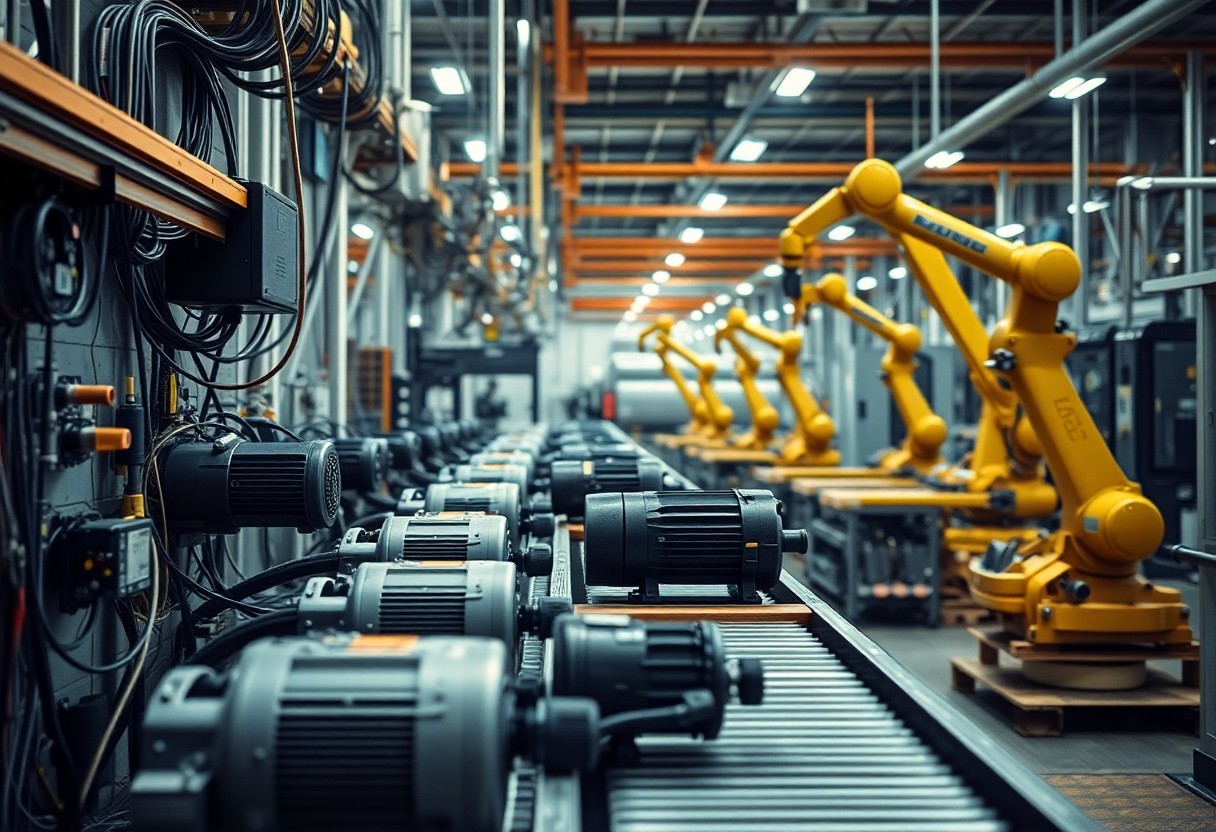
You will discover how electromotors play a pivotal role in enhancing industrial automation processes. By converting electrical energy into mechanical energy, these devices improve efficiency and enable precise control within your operations. Understanding their impact will help you reduce production costs and minimize risks associated with mechanical failures. As industries evolve, recognizing the positive benefits of electromotors becomes vital for maintaining a competitive edge.
Types of Electromotors
| Type | Description |
|---|---|
| AC Motors | Commonly used in industrial applications for their efficiency. |
| DC Motors | Valued for their precise speed control. |
| Stepper Motors | Ideal for applications requiring exact positioning. |
| Servo Motors | Utilized for their high torque and precise control. |
| Brushless Motors | Preferred for their reliability and low maintenance. |
AC Motors
AC motors are widely utilized in industrial automation due to their efficiency and cost-effectiveness. They operate using alternating current and can be categorized into two main types: synchronous and asynchronous motors. Synchronous motors maintain synchronization with the supply current, which allows for highly accurate speed control, while asynchronous motors, often referred to as induction motors, are simpler in design and more commonly used in applications where speed flexibility is less critical.
Your choice of AC motor will depend on the specific requirements of your application. For instance, in conveyor systems, electric fans, and pumps, AC motors deliver the seamless operation necessary for continuous processes. They benefit from lower initial costs and maintenance expenses, making them an attractive option for many industrial setups. Recognizing the advantages of AC motors can substantially enhance operational efficiency.
DC Motors
DC motors are crucial in applications requiring immediate torque and speed control. These motors operate on direct current and are favored in situations where precision is key. Their ability to vary speed through voltage adjustment makes them highly adaptable for tasks ranging from robotics to elevators. You can find brushed and brushless types, each offering distinct advantages in longevity and maintenance.
Brushed DC motors are typically simpler and cheaper, thus often utilized in smaller devices, while brushless DC motors are favored for their increased efficiency and performance. Depending on your application, selecting the appropriate DC motor can significantly impact performance and reliability. Recognizing the nuances between these types plays a pivotal role in optimizing your automation solutions.
Stepper Motors
Stepper motors operate by dividing a full rotation into smaller, precise steps, enabling highly accurate control over positioning. They are especially useful in applications such as 3D printers and CNC machines, where meticulous control is paramount. Unlike other motor types, steppers can achieve precise increments without the need for feedback systems, allowing for simpler control mechanisms in your processes.
Your choice to implement a stepper motor can enhance the precision of automated systems. These motors are robust yet provide the necessary power to handle a variety of industrial tasks. Recognizing their unique properties and applications can assist you in making informed decisions that drive productivity and accuracy in your operations.
Servo Motors
Servo motors are known for their high efficiency and precision control, making them ideal for automated systems that require quick responses. Typically equipped with feedback sensors, servo motors continuously adjust their position based on the input signals they receive. This real-time adjustment allows for smooth, accurate movement, crucial in robotics and CNC applications.
Your implementation of servo motors can significantly elevate the accuracy and capabilities of automated machinery. These motors are built to execute faster and more complicated tasks than their counterparts, providing the competitive edge necessary in today’s industry. Recognizing the benefit of their feedback systems can lead you to better overall system performance.
Factors Influencing Electromotor Selection
When deciding on an electromotor for your industrial automation needs, understanding the primary influences can streamline your decision-making process. You will want to consider aspects such as load requirements, efficiency considerations, and control methods. Each factor plays a significant role in ensuring that the chosen motor aligns with your operational demands and energy usage. This selection process can increase reliability and performance in your automation systems.
Load Requirements
Your first consideration should be the specific load requirements of your application. Each motor must be capable of handling the instantaneous and continuous load it will experience in operation. For instance, if you are driving a conveyor system with intermittent high loads, you would need a motor with a higher capacity to manage these peaks without overheating or failing. Additionally, understanding the torque requirements for your application will help ensure that the motor operates within optimal parameters.
The load profile can be categorized into two main types: constant load and variable load. Constant loads remain stable over time, allowing for easier motor selection. Conversely, variable loads fluctuate significantly, requiring motors with adjustable performance features, like variable speed drives, to adapt to changing demands efficiently. Assume that understanding these parameters will help you make a well-informed decision regarding motor choice and performance reliability.
Efficiency Considerations
Efficiency is another prominent factor that impacts your electromotor selection. Motors with higher efficiency ratings consume less electricity for the same output, leading to lower operational costs and a reduced carbon footprint. An efficient motor can significantly enhance your system’s overall performance and sustainability. When evaluating efficiency, you should examine the motor’s design, including factors like winding materials and thermal characteristics, which can affect energy loss.
Opting for high-efficiency motors may involve a higher initial investment, but the long-term savings on energy bills and maintenance make them a wise choice. Various motor efficiency standards, such as NEMA Premium and IE3, can guide your selection. Assume that incorporating such efficient motors into your operations will result in quantifiable savings and a more environmentally friendly operation.
Control Methods
Control methods are vital when assessing electromotor options, particularly in applications requiring precise speed regulation. Your choice influences not only the performance but also the ability to achieve variable speed control. Direct-on-line starters work for simpler tasks, while more complex applications benefit from using variable frequency drives (VFDs), which enable adaptable motor speed to match operational requirements effectively.
Advanced control methods, like sensorless vector control and field-oriented control (FOC), can enhance torque response and precision. Assume that these technologies allow for better energy savings and system control, paving the way for innovations in automation capability. These changing dynamics make understanding control methods a key aspect of effective motor selection.
Pros and Cons of Using Electromotors in Industrial Automation
Pros and Cons of Electromotors
| Pros | Cons |
|---|---|
| High efficiency in energy use | Initial installation cost can be high |
| Low maintenance requirements | Potential heat generation may require cooling systems |
| Versatility in applications | Risk of electronic faults can lead to downtime |
| Improved precision and control | Dependence on electricity makes them vulnerable in outages |
| Compact design allows for space-saving setups | Limited performance in extreme temperatures |
| Environmentally friendly options available | Noise can be a concern in certain applications |
| Rapid start-up and stop capabilities | Complexity in troubleshooting electrical issues |
| Integration with automation systems | Requires understanding of electrical systems for optimal use |
| Ability to handle variable loads effectively | Can be less effective for high-torque applications |
| Support for IoT connectivity in modern setups | Limited lifespan compared to some mechanical systems |
Advantages
One of the prominent advantages of using electromotors is their high efficiency, which translates to significant savings in energy costs over time. By operating with low losses, you can expect reduced operational expenses, especially in large-scale manufacturing. Additionally, their low maintenance requirements minimize the need for frequent inspections or repairs, ultimately enhancing productivity. This efficiency and reliability make them ideal for various applications, ranging from conveyor systems to robotic automation.
Moreover, electromotors provide exceptional precision and control, allowing you to fine-tune processes with accuracy that mechanical counterparts often struggle to achieve. The versatility in applications is another key benefit, as they can be adapted for a wide range of tasks across different industries, such as food processing, material handling, and automotive assembly. Their compact design also contributes to space-saving setups, which is increasingly valuable in modern manufacturing environments requiring maximum efficiency.
Disadvantages
On the downside, the initial installation cost of electromotors can be a barrier for some operations, as it may require significant investment upfront. Additionally, they can generate heat during operation, necessitating cooling systems to maintain optimal performance and prevent damage. This can complicate your setup and increase ongoing expenses. Furthermore, reliance on electrical systems means that any failure can lead to costly downtime.
These disadvantages also encompass the intricacies involved in maintaining electromotors. You might face challenges related to troubleshooting electrical issues, as they often require specialized knowledge. Their performance might be hindered in extreme environmental conditions, further emphasizing the need for careful consideration during the selection process. In high-torque applications, their effectiveness can diminish, which may limit your operational versatility in specific scenarios.
Tips for Optimizing Electromotor Performance
Improving the performance of your electromotor can significantly enhance overall efficiency in industrial automation. Several strategies can be employed to ensure optimal performance. First, properly setting the operating parameters, such as voltage and current, is vital for maintaining efficiency. Additionally, selecting high-quality components and correct lubricants minimizes friction and wear, enhancing lifespan and reliability.
- Regularly inspect for signs of wear and tear.
- Implement vibration analysis to detect potential issues early.
- Keep the motor clean and devoid of dust or debris.
- Utilize advanced monitoring systems to track performance metrics.
Knowing that these practices support longevity will foster a more dependable production process.
Maintenance Practices
Consistent and proactive maintenance practices are vital for the longevity and efficiency of your electromotors. Regular inspections should include checking wiring for damage, listening for unusual noises, and monitoring operating temperatures. Establishing a routine that includes these checks helps in identifying potential issues before they escalate into costly failures.
Furthermore, employing predictive maintenance technologies, such as condition monitoring and diagnostic tools, allows you to track the health of your motors continuously. This approach not only aids in extending their service life but also ensures that you operate within optimal performance thresholds, reducing the risk of unexpected downtime.
Proper Sizing
Choosing the correct size of the electromotor is fundamental to maximizing performance and efficiency. Motors that are too small can lead to overheating and premature failure, while oversized units may waste energy and result in unnecessary costs. To determine the right motor size, evaluate your application’s requirements including load characteristics, operational duty cycle, and other environmental factors.
Take into consideration the specifics of your application and any fluctuations in demand. For instance, if your process experiences varying loads, a motor with a larger capacity may be beneficial. Conversely, precise calculations based on typical operational parameters can help you select sizes that align closely with your actual needs. Implementing software tools designed for motor sizing can aid in this process and ensure more accurate selections.
Knowing the importance of proper sizing will lead to better energy efficiency and performance in your operations.
Step-by-Step Guide to Implementing Electromotors
Assessment of Needs
Begin by conducting a thorough assessment of your operational requirements. Identify the specific tasks that need automation and determine the type of motion required, such as linear or rotary. Evaluate existing equipment and processes to establish where electromotors can add the most value, targeting areas like efficiency improvements or reducing downtime.
In your analysis, consider factors such as load capacity, required speed, and torque characteristics. Use metrics to quantify these needs, such as production rate improvements or energy consumption reductions. Align your electromotor selection with the overall goals of your automation project, ensuring the technology you choose enhances productivity and meets performance standards.
Integration into Existing Systems
Integration is a pivotal step that involves seamlessly connecting new electromotors to your existing systems. Assess the compatibility of current infrastructure with the electromotor you have selected. This includes checking for interface requirements, electrical standards, and network protocols to ensure smooth communication and operation.
You may need to make provisions for software updates or hardware modifications to accommodate the new technology. Engage with your engineering team to map out integration steps, ensuring minimal disruption during the implementation phase. Consider the use of programmable logic controllers (PLCs) for effective integration, allowing for better control and monitoring of motor functions.
Testing and Calibration
Testing and calibration are crucial after installation to ensure your electromotors perform optimally under load. Begin with a comprehensive performance test to evaluate responsiveness, speed, and load handling. This may involve running the system through various operational scenarios to capture data on performance metrics.
Following initial tests, calibrate the motors based on your findings. Adjust parameters such as acceleration, deceleration, and operational thresholds to fine-tune their performance. Continuous monitoring during this phase is vital to ensure that any anomalies are addressed promptly, helping to mitigate risks and enhance reliability.
Incorporate feedback loops in your testing process, using data analytics tools to assess performance over time. Doing so allows you to refine operational settings, ensuring that the electromotors not only meet but exceed their designed specifications.
Future Trends in Electromotor Technology
Advances in Efficiency
As the demand for sustainable and efficient industrial practices grows, electromotor technology is advancing to meet these needs. New designs, such as permanent magnet motors, significantly enhance energy efficiency, often exceeding 95% in certain applications. These motors reduce energy consumption and operational costs, making them an attractive choice for businesses aiming to lower their carbon footprint while optimizing productivity.
Additionally, innovations like the implementation of advanced materials, such as lightweight composites, help in reducing the overall weight and increasing the power-to-weight ratio of motors. This shift boosts performance and accelerates speed in industrial processes, thereby improving response times and operational agility. Users benefit from motors that not only perform better but are also easier to integrate into existing systems.
Smart Motors and IoT Integration
The rise of smart motors signifies a transformative trend in industrial automation. By incorporating IoT technology, motors can now provide real-time data on performance metrics, such as temperature, vibration, and energy consumption. These insights allow you to proactively address maintenance needs, reducing downtime and enhancing productivity. Predictive analytics can forecast failures before they occur, enabling you to implement timely interventions.
Integration with IoT systems enhances your ability to monitor and control electromotors remotely. For instance, with smart motors, you can adjust operational parameters based on live data, optimizing energy use and improving overall efficiency. This capability is particularly beneficial in environments requiring numerous motors to work in tandem, facilitating coordinated control and synchronization of operations.
Smart motors’ integration with the IoT also opens avenues for enhanced data analytics. Using machine learning algorithms, these systems can identify patterns in performance over time, allowing you to refine operational strategies and improve productivity. As a result, this technology not only boosts efficiency but also transforms maintenance practices and operational decision-making in industrial settings.
Conclusion
Considering all points, the integration of electromotors into your industrial automation processes fundamentally enhances operational efficiency and productivity. By utilizing these motors, you can achieve precise control over machinery, minimize downtime through reliable performance, and optimize your energy consumption. This efficiency translates into significant cost savings and an improved bottom line for your business.
Furthermore, as you adopt advanced electromotor technologies, such as servo and stepper motors, you gain access to greater flexibility and scalability within your operations. This adaptability allows you to respond swiftly to market demands and innovate without being constrained by outdated machinery. As you embrace these advancements, your enterprise positions itself at the forefront of industry competitiveness.

Comments are closed