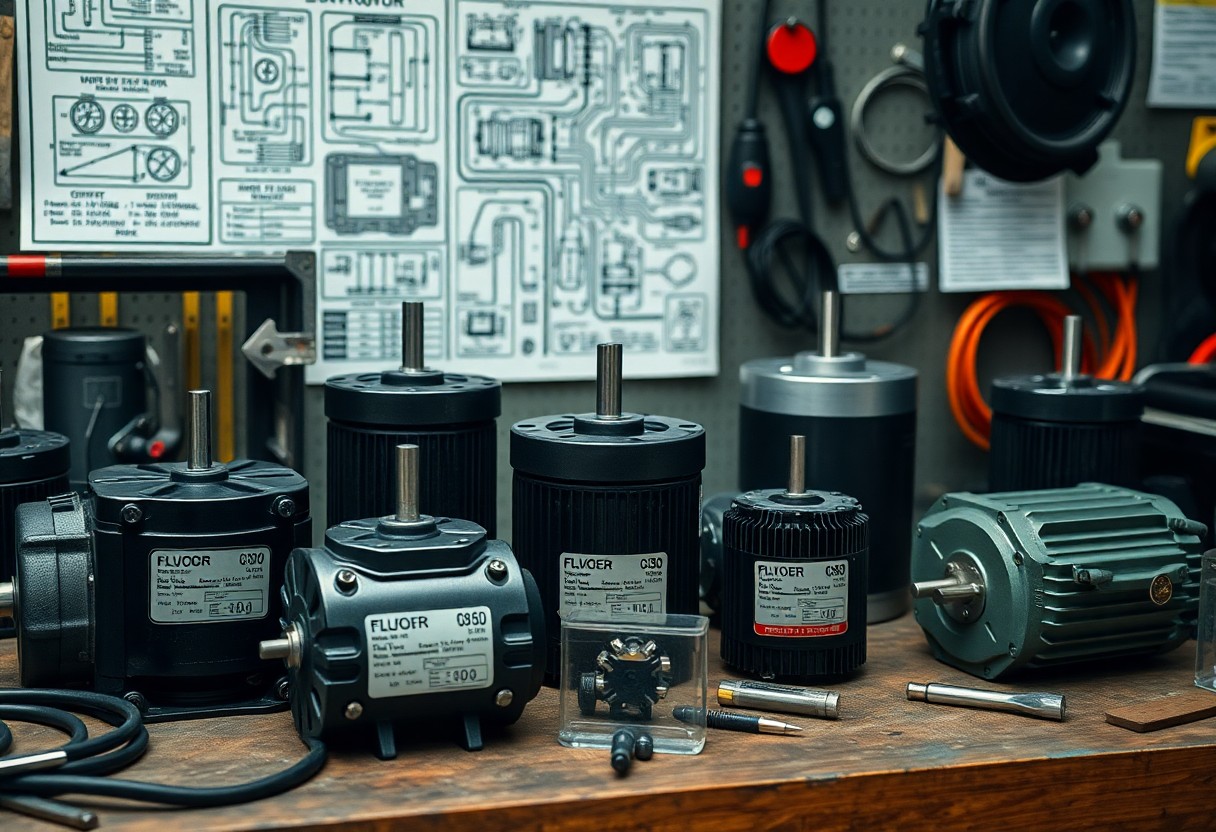
Over the years, selecting the right electromotor has become imperative for achieving optimal performance in your projects. You must consider factors like power requirements, efficiency ratings, and size limitations to ensure safety and effectiveness. Choosing incorrectly can lead to project delays and increased costs. By understanding your application’s specific needs, you can make an informed decision that enhances productivity and reliability, providing long-term benefits for your projects.
Understanding Electromotor Types
In the matter of selecting an electromotor, it’s imperative to grasp the different types available. Each category offers various benefits and specifications, aligning with specific project requirements. Here’s a concise breakdown of the main types:
| Type | Description |
|---|---|
| DC Motors | Commonly used for applications requiring variable speed control. |
| AC Motors | Ideal for higher power applications, offering reliability. |
| Stepper Motors | Perfect for precise positioning, commonly seen in robotics. |
| Servo Motors | Used in applications needing precise control and feedback. |
| Specialty Motors | Includes various designs tailored for unique applications. |
DC Motors
The DC motor operates on direct current and is known for its simplicity and efficiency. These motors are favored when you need smooth speed regulation and easy reversing capabilities. They are typically more cost-effective, making them a popular choice in various applications including robotics and toys.
With a wide voltage range, the DC motors can deliver high torque at low speeds, which is imperative in scenarios requiring controlled motion. However, they have limitations, such as a shorter lifespan due to brush wear and the need for more frequent maintenance.
AC Motors
AC motors are predominantly used in industrial environments due to their durability and efficiency. They can be categorized mainly into induction motors and synchronous motors, each serving different functions based on the application’s power requirements. Induction motors, for example, are commonly found in household appliances and HVAC systems.
Another significant advantage of AC motors is their ability to handle high power levels while remaining low maintenance. They operate on alternating current, providing a consistent speed and torque without the wear that can affect DC variants.
After evaluating your needs, you’ll find that AC motors are excellent for applications demanding continuous operation and minimal downtime, as they can handle larger loads with greater efficiency.
Stepper Motors
Stepper motors divide a full rotation into equal steps, allowing for precise control over angular position. Their unique design makes them ideal for applications requiring accurate positioning, such as 3D printers and CNC machines. Unlike other motor types, they maintain their position when unpowered, enhancing their utility in static applications.
These motors excel when paired with digital controllers, providing a means for intricate movement and automation. It’s important to understand that while stepper motors provide great precision, they may not be suitable for high-speed applications due to resonance issues that can arise when operating at certain frequencies.
After assessing your project needs, consider how stepper motors could fulfill requirements for accountability, especially when positioning accuracy is needed over speed.
Servo Motors
Servo motors are renowned for their precise control, making them imperative in robotics, automation, and telemetry systems. They utilize feedback mechanisms to maintain accuracy in position, speed, and torque, often incorporating a built-in encoder for real-time adjustments. The high performance of servo motors facilitates better motion control compared to other motor types.
Additionally, these motors often have a higher initial cost but are justified by their performance and reduced development time in projects requiring frequent adjustments. The versatility and reliability of servo motors make them invaluable in high-precision applications.
After thorough analysis, reflect on the performance and feedback capabilities of servo motors when determining the best fit for your project’s needs.
Key Factors to Consider
When deciding on the right electromotor, several key factors must be assessed to ensure optimal performance and compatibility with your application. First and foremost, you need to evaluate the power requirements of your project. This involves determining the voltage and current your system will use, which can significantly influence the overall efficiency and longevity of the motor. It’s also imperative to consider the operating environment, since conditions such as temperature, humidity, and exposure to dust or chemicals can impact the motor’s performance. You should take into account the intended application and how these factors align with specific motor features.
- Power requirements
- Speed and torque
- Operating environment
Thou should not overlook the significance of these attributes when choosing the right electromotor for your needs.
Power Requirements
To start, calculating your project’s power requirements is vital. Consider the load the motor must drive, as well as any peak power demands that may arise during operation. You have to determine if the motor can handle continuous loads as well as any potential spikes. An example would be a conveyor belt that experiences heavy loads when loaded but operates at a lower capacity during regular running. Selecting a motor with a power rating higher than the calculated requirements can provide a safety buffer, promoting longevity and reliability.
Your choice should also reflect the operational voltage that your application requires. Standard voltages include 12V, 24V, or even 48V systems, especially in DC motor applications. Mismatched voltage can lead to inefficiencies or even motor failure. Therefore, it is always advisable to consult the manufacturer’s specifications to ensure compatibility with your system.
Speed and Torque
The speed and torque specifications of the electromotor determine how well it can perform under varying load conditions. Speed is typically measured in revolutions per minute (RPM), while torque refers to the rotational force exerted. For high-speed applications, such as fans or pumps, selecting a motor that can deliver sufficient RPM while maintaining reliable torque is imperative. Conversely, applications requiring high starting torque, like elevator systems, demand motors that can provide significant force at low speeds.
When evaluating these specifications, consider the relationship between speed and torque in your system. Motors can be designed for high torque at low speeds or high RPM with lower torque output, depending on your needs. Thus, it’s imperative to know the requirements of your specific application to find the right balance. A motor that lacks torque may struggle under load, while one that can’t reach the required speed could halt your operations.
Operating Environment
The operating environment of the electromotor plays a significant role in its performance and longevity. You should assess whether your application is indoors or outdoors, exposed to moisture, temperature fluctuations, or dust. For instance, motors used in outdoor applications require protective housings or specific coatings to withstand environmental elements. You may need a motor designed for high humidity if you’re operating in a wet environment, such as a wastewater treatment facility. This ensures durability and reduces the chances of overheating or corrosion, which could lead to failures.
Furthermore, make sure to consider any vibrations or shock your motor might face during operation. Selecting a motor with robust mounting options can mitigate the effects of these stresses, prolonging the component’s lifespan. Thou must also take note that high temperatures can affect not just the motor’s operation, but its insulation materials as well, impacting efficiency.
Pros and Cons of Different Electromotors
Pros and Cons Summary
| Pros | Cons |
|---|---|
| High efficiency | Initial cost can be high |
| Low maintenance requirements | Limited torque at low speeds |
| Wide range of sizes and types | Noise levels can be an issue |
| Good speed control | Heat generation during operation |
| Environmentally friendly options available | Dependency on electrical sources |
| Long lifespan | Complexity in some control systems |
| High starting torque for some types | Not suitable for all applications |
| Easily integrated with automation | Potential for overheating |
| Versatile applications | Need for proper sizing and selection |
| Improved performance with advancements | Varying reliability based on quality |
Advantages
When choosing an electromotor, you can take advantage of their high efficiency, which can greatly reduce energy costs over time. Many modern designs feature improvements that boost performance while minimizing energy consumption. This efficiency is vital for projects where reducing operational costs is imperative. Additionally, the low maintenance requirements associated with electromotors mean less downtime and fewer service interruptions, ultimately leading to enhanced productivity in your applications.
The versatility of electromotors is another significant advantage. You can find models tailored for a wide range of applications, from industrial machinery to household appliances. Some types also offer excellent speed control, allowing you to fine-tune performance to suit specific needs. With options available in various sizes and output specifications, it’s likely you’ll find the perfect fit for your project. Moreover, many electromotors are designed to be environmentally friendly, making them suitable for sustainable engineering practices.
Disadvantages
Despite the numerous advantages, electomotors also present several disadvantages that you should consider. One of the primary drawbacks is the initial cost, which can be steep depending on the type and capacity of the electromotor. You may also encounter noise levels that could affect your work environment, especially in residential settings. Additionally, many models face limitations when it comes to torque at low speeds, which may pose challenges in specific applications where high starting torque is imperative.
Furthermore, the dependency on electrical sources can limit flexibility, as you’ll need a reliable power supply to operate these motors efficiently. Heat generation during operation is another concern; if not managed properly, it could lead to overheating and equipment failure. You also need to pay close attention to sizing and ensuring you choose an appropriately rated model for your project, as incorrect sizing can lead to performance issues and inefficiencies.
Step-by-Step Guide to Selection
Assess Your Project Needs
Begin by clearly defining the requirements of your project. Consider factors such as the application type, power requirements, and environmental conditions. For instance, if you are powering a small robotic arm, your focus should be on a motor that offers precise control and adequate torque. If it’s for a larger industrial machine, durability and continuous operation are key elements to evaluate.
Next, identify constraints such as space limitations and budget. Knowing your maximum dimensions and financial considerations will help narrow down your options significantly. Create a checklist of these requirements to refer back to as you begin your search.
| Factor | Details |
| Application Type | Robotics, industrial, automotive |
| Power Requirements | Voltage and current needs |
| Environmental Conditions | Temperature, humidity, dust |
| Space Limitations | Motor dimensions |
| Budget | Cost estimation |
Research Suitable Motor Types
Once you have a solid understanding of your project needs, probe into various motor types that might fit your criteria. Consider AC motors for applications requiring consistent speed, or DC motors for applications needing variable speed control. Additionally, look into stepper motors for precise positioning tasks, or servo motors for applications that require high torques and positional accuracy.
Familiarizing yourself with the pros and cons of these types can lead to optimal choices. While AC motors are often more efficient and durable, DC motors can provide greater flexibility in speed and power. Stepper and servo motors, though typically more expensive, offer distinctive advantages in precision and control. This understanding will help you pinpoint the best motor type for your project.
| Motor Type | Characteristics |
| AC Motors | Efficient, durable |
| DC Motors | Variable speed, versatile |
| Stepper Motors | High precision, controlled movement |
| Servo Motors | High torque, positional accuracy |
| Brushless Motors | Long lifespan, reduced maintenance |
Evaluate Performance Specifications
With suitable motor types identified, it’s time to assess the performance specifications that matter most to your project. Key metrics include torque ratings, RPM (revolutions per minute), and efficiency ratings. For example, if your application requires high acceleration, you’ll want a motor capable of delivering significant torque at lower RPMs. Alternatively, if energy savings are imperative, compare the efficiency ratings of different motors to find the optimal choice.
Consider also the operating temperature range, as exceeding this can lead to performance degradation or failure. If your application involves high heat, select a motor rated for elevated temperatures. Balancing these performance specifications will enable you to better align your motor selection with the demands of your project.
Make an Informed Choice
After completing your evaluations, it’s important to consolidate your findings and make a well-informed decision. Cross-reference your project needs with the specifications and characteristics of potential motors to determine the best fit. Don’t hesitate to consult with experts or manufacturers, as they can provide valuable insights and recommendations tailored to your specific application.
Finally, factor in considerations such as warranty and support provided by manufacturers, which can influence the reliability of your choice. This step not only solidifies your decision but also ensures you select a motor that enhances your project’s overall efficiency and effectiveness.
Tips for Optimal Motor Selection
When dicking out an electromotor, you should prioritize both specifications and operational conditions. Understanding the context of your project will save time and reduce costs in the long run. Look into factors such as the voltage requirements, the torque needed, and the speed at which the motor must operate. Additionally, assess the environmental factors your motor will be exposed to; for example, if it will be used in a wet or high-temperature area, specialized motors may be required.
Utilize the following tips to narrow down your options:
- Assess the load that the motor will drive.
- Choose a motor that meets your power needs efficiently.
- Consider maintenance needs and access.
- Evaluate space constraints for installation.
- Optimize for energy efficiency to save costs.
Assume that by following these guidelines, you can select the best motor that aligns with both your immediate project and potential future expansions.
Consult with Experts
Engaging with professionals in the field can provide insights that may not be apparent through basic research. Reach out to engineers, manufacturers, or distributors who can give you direct advice based on their experience. These experts help you identify the right specifications, ensuring that no detailed aspect is overlooked. Additionally, industry associations or networking groups can serve as valuable resources for recommendations and best practices.
You might also consider partnering with consultants who specialize in electromotor applications. They can analyze your specific situation, taking into account your operational environment and the desired outcomes. Their expertise could prevent costly mistakes and streamline your selection process.
Review User Feedback
User reviews offer a wealth of information that can guide your selection process. They can reveal both the strengths and weaknesses of specific motors, providing you with a clearer picture of real-world performance. For instance, customers often share their experiences regarding the durability, maintenance requirements, and efficiency of various models. This information can be invaluable in making an informed decision.
Online platforms and industry forums provide comprehensive user feedback. Scrutinizing reviews from verified purchasers helps you gauge a motor’s long-term reliability. Pay particular attention to recurring issues or often-praised features, as these insights directly relate to your intended application.
Consider Future Needs
Keeping your future requirements in mind is necessary when selecting an electromotor. Technologies evolve, and so do project demands. If you anticipate scaling your operations, opt for a motor with flexible capabilities that can adapt to increased workloads or efficiency standards without necessitating a complete system overhaul.
Thinking ahead allows you to invest in a motor that remains relevant for years to come. Evaluate factors such as compatibility with future upgrades in your systems, and potential energy efficiency improvements available in newer motor models. This foresight ultimately leads to reduced downtime and enhances operational productivity over the lifespan of your project.
Final Words
Taking this into account, selecting the right electromotor for your project involves evaluating specific factors such as power requirements, efficiency, and size constraints. You should first assess the operational demands of your application to determine the appropriate type and specifications of the electromotor. Make calculations on torque, speed, and the environmental conditions in which the motor will operate, ensuring it aligns with your project’s goals and expectations.
Your final choice should also consider the long-term reliability and support from manufacturers. Investigate warranties, maintenance needs, and availability of replacement parts to ensure smooth operation over time. By carefully balancing performance, durability, and cost, you can confidently select an electromotor that best meets your project’s needs, ultimately enhancing its success.

Comments are closed